Myths, Tales, Folkore, and Fairies

Greetings, my beloved, estranged, and neglected blog!

A lot of things have been happening in my life these past few months which I will blame entirely on my absence and not my extreme lack of self-control and questionable work ethic.

In April, I left my long-time barista job for better prospects: …a less than enthusiastic venture into waitressing. The money was fantastic (but hard earned) and the people charmingly miserable about their jobs yet astoundingly pleasant to be around. But as the weekends disappeared all together and the doubleshifts mounted, I was suddenly without free time and hopelessly short on motivation–nursing that couch and Netflix queue like a cure-all. I arrived at the conclusion quite rapidly that I needed to be free so I quickly went out and got myself a big girl job and life has been pretty grand since!

I managed to kick out a video game article in the mean time, but now I’m ready to get back into research and history! Which brings me to my new project idea…during one of my many recent Netflix binges, I stumbled across Once Upon a Time. And while it’s not exactly Sopranos level of television delicacy, I enjoy it quite a bit as well as the new found spark I have for the stories that inspired it. I can’t help but feel like I’m extremely out of touch with our cultural milestones of yester-year, and it’s certainly been ages since I popcorn-read Heracules in front of 12-year-old peers, internally admonishing them all for mispronouncing half of the names. In fact, I must admit, even as much strength my relationship with History has, I have been rather neglectful of it for quite some time…having not actually READ some of the most famous texts including Beowulf, Tales of Genji, and the Epic of Gilgamesh for starters.

Well, of course, this will be my new mission going forward. Roughly attempting to start from the beginning in a lenient chronological order, I will be going back to the basics, so to speak. Looking over and finally reading the stories that have spanned across time and this world since we’ve collectively decided that writing things down goes beyond economic list-keeping usefulness.

So, if you’re still with me and plan on being with me (hopefully less tentatively this time), I plan on covering the big stories from big civilizations in history and, maybe, if I find some good sources, the not so big ones. And like all decent History blogs should, I’ll make sure to keep everyone well briefed on the subjects at hand as I move through my work!

Next up, I’ll be dabbling in Ancient Sumeria…

UNESCO World Heritage Sites 2014: Piedmont, Italy.

It’s time folks!

UNESCO is putting together a new vote on the latest World Heritage sites, the best preservation technique the modern world has to offer. The chosen sites are being announced as I type this, but I’m sure all of you are wondering (including myself, honestly) what some of the significance behind these historical sites may be. And as one of my childish dreams (while I toil away with an AA degree in the service industry) is to one day work with UNESCO on these sites, I’ll be doing my own personal PR digging and pretending I’m some how a part of all of this grand occasion by doing a little research into the history of our new World Heritage Sites.

Vineyards of Piedmont, Italy.

Vineyards of Piedmont, Italy.

Most people have probably not heard of Piedmont, frankly, I being one of them. I have, however, heard of all of the peoples at one time being in control of this expansive Italian region. That being in a particular order: Celtic tribes, Romans, Burgundians, Goths, Byzantines, Lombards, Franks, Holy Roman Empire…sounds pretty familiar across Europe, no? And after all this confusion to claims, Piedmont eventually emerged as the Kingdom of Sardinia dating from the good ol’ Italian Renaissance to around the more modern 19th century. In fact, the region is no stranger to the heritage fame with the Palazzina di caccia of Stupinigi (save the jokes, please) being added to the listed, once belonging to the House of Savoy which acquired the kingdom in 1720AD.

Someone probably went "Baroque" after building this. *crickets*

Someone probably went “Baroque” after building this. *crickets*

But what Piedmont had been REALLY famous for was the booze. Or, in this case, a spectacular ability to make fantastic wine for loooong times. It was well known for its vines even in Ancient Roman times back when civilians guzzled wine like water with Pliny the Elder noting that the Piedmont region was the most favorable for growing. And that was back in 77BC, with about 2000 years in between, and Piedmont is still kickin’ the grapes with wrath. Again, when you consider how many various civilizations conquered (or re-conquered) the region, it’s a miracle the environment remained as relatively intact as it is today, especially since those dirty ancestor’s of ours loved to “salt the earth” whenever they didn’t feel like sharing.

Of related note to all this wino business was how strangely influential the grape was to the very essence of Italian culture, notably, the Italian Unification which is the whole gosh darn reason we have an Italy today. Ever heard of Giuseppe Garibaldi? The name should ring a bell, but if not, he was that dude who kicked the shit all over the world as well as personally super gluing the various Italian states together with his fantastic beard. Well, he was also a big-time winemaker who introduced the happy science French mixture to help protect the area’s vineyards. Because if there is one thing France was actually any good at defending…it was the wine. And, reminiscent of the elementary school tales of the American Revolutionary War where we all learned that Bostonians got super bloody peeved when their Earl Grey got taxed, the Austrians decided to double the tariffs of the Piemontese wine with predictable results which sort of kick-started the whole independence thing in the first place.

So, it makes sense that UNESCO would name the Vineyards of Piedmont, Italy as a World Heritage Site, an area that includes 5 wine-growing areas and the Castle of Cavour for good measure. Now we all have an excuse to go all Bacchus on this news, right?

Aww, isn't it cute?

Aww, isn’t it cute?

300: Rise of Artemisia

This is happening.

No one really expects a film based on a graphic novel based on a historical event to remain loyal to the latter. Source material taken from any form whose primary audience pounds out their vicious objections to any embellishments on a keyboard caked with Doritos residue and the sticky remains of a novelty energy drink, is going to be taken more seriously than a few scattered nerds nose deep in Herodotus’ The Histories. Mostly because the first group has the unique and senseless ability of lambasting anything they love to hate with enough down-votes across social media, even Mussolini would feel popular. So with the now swiftly approaching release date of Warner Bros’ 300: Rise of an Empire, I doubt anyone is supremely concerned with historical accuracy. I’m guessing the main discussion sparks with a critique of slow-mo, how realistic and plentiful painted abdomens will be, and a nostalgic exchange of celebratory memes.

Yield at ‘Madness’

But if there is one thing I really do hope, nay, EXPECT, the movie to get right, is the characterization of Artemisia.

For a film promising to portray itself in an epic scope and deliver on all that delicious violence and bloodshed, there really isn’t an absence of it in the source material. And when it comes to Artemisia, no one, not even thousands-of-years-dead historians, can deny that she was a sassy man-trouncing Mutha’Amourous Congresswoman‘.

Artemisia was queen of the Persian providence of Caria, which she gained because her son was still a noob-fledgling after her husband died. Clearly, nobody gave a shit about him though because I never came across a name for the father, or even the son for that matter, in my readings. And who the hell would when Artemisia was bringin’ the feminism as the only female naval commander in a time period when women were expected to cover themselves to protect their chastity. (Apparently, Cyrus the Great’s influence…clearly not in relation to Miley Cyrus as she believes in neither of those things)

Her story predominately begins with the various re-tellings of the Greco-Persian wars, which for the folks who are here because of 300, are the collection of battles between Persia and the city-states of the Greek world. Not much is really known about Artemisia’s life beyond what battles she contributed her skill in and Herodotus offers little insight beyond an awe of confusion over her presence at all given this text:

There is no need for me to mention all the other subordinate officers, but there is one name which I cannot omit—that of Artemisia. It seems to me a marvel that she—a woman—should have taken part in the campaign against Greece.

But since he was Greek, there’s really no surprise there. Actually, I would infer that because Herodotus himself was born in Halicarnassus of Caria, then under the rule of Artemisia’s grandson continuing a somewhat familial regional legacy, he would find her loyalty surprising given his own rather than in full part because of any misplaced view on women. Clearly, he did have some respect for her, referring to her reasons for joining under Xerxe’s command as

there was consequently no necessity for her to do so. Her own spirit of adventure and manly courage were her only incentives.

But that probably has to do with the common association of comparing her accomplishments to that of a man and not a woman, which I will show more of in a bit. Either way, despite her gender, she was well known for her wisdom and intelligence, being one of Xerxes’ most promising advisers. Right before the (SPOILER ALERT: “ill-fated”) Battle of Salamis, Xerxes sent his lead military commander Mardonius [Remember this quote, guys?] to each one of his fellow commanders to retrieve their advice for the king on their opinion about raging a sea battle against the Greeks. Every single one of them, save for Artemisia, was in favor of engaging in the tactlessly arrogant attack. Without missing a beat or sparing offense, she is said to have replied with these ‘kind’ words;

Mardonius, tell the king for me that this is the answer I give—I, whose courage and achievements in the battles at Euboea were surpassed by none: say to him, “Master, my past services give me the right to advise you now upon the course which I believe to be most to your advantage. It is this: spare your ships and do not fight at sea, for the Greeks are as far superior to your men in naval matters as men are to women. In any case, what pressing need have you to risk further actions at sea? Have you not taken Athens, the main objective of the war? Is not the rest of Greece in your power? There is no one now to resist you—those who did resist have fared as they deserved. Let me tell you how I think things will now go with the enemy; if only you are not in too great a hurry to fight at sea—if you keep the fleet on the coast where it now is—then, whether you stay here or advance into the Peloponnese, you will easily accomplish your purpose. The Greeks will not be able to hold out against you for long; you will soon cause their forces to disperse—they will soon break up and go home. I hear they have no supplies in the island where they now are; and the Peloponnesian contingents, at least, are not likely to be very easy in their minds if you march with the army towards their country—they will hardly care to fight in defense of Athens.
If, on the other had, you rush into a naval action, my fear is that the defeat of your fleet may involve the army too. And put away in your heart on other point, my lord, to be considered: good masters, remember, usually have bad servants, and bad masters good ones. You, then, being the best master in the world, are ill served: these people who are supposed to be your allies—these Egyptians, Cyprians, Cilicians, Pamphylians—are a useless lot!

The rest of the commanders held their breath, sucked in their retorts if they were included in the closing insult, or waited eagerly for Xerxes to put her silly inferior brain in place. Too bad for them though, that Xerxes, who usually has such sound judgments more in line with their intellectual capacity, greeted Artemisia’s opinion with the most highest of esteem, in fact notably encouraging her with more favor for giving such an admirable and sound advising. However, though pleased with Artemisia’s skepticism, Xerxes’ astronomically amorphous ego was certain that his presence alone would foster victory where it had since lacked. And so the Battle of Salamis was soon underway.

"WHY ISN'T MY FACE MAKING THEM WIN?!"

“WHY ISN’T MY FACE MAKING THEM WIN?!”

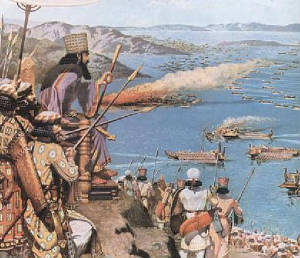
So, presumably not all that begrudging given her affection for baddassery, Artemisia sailed into battle regardless. According to Polyaenus (A Macedonian author who dedicated one of his works to Marcus Aurelius *bravo*), in battle, Artemisia’s long ship carried different flags, Greek, Barbarian, etc. which she would fly intermittently given her chosen enemy, the ability to sneak attack unawares. She used this technique in full when, after her comrades and allies fell apart in abstract chaos in the wake of their combined utter defeat, she found herself being chased by an Athenian Trireme with no chance of escape as she was completely surrounded by enemy and friendly ships alike. Throwing up the colors and ramming a friendly ship captained by the king of Calynda, Damasithymus, she made herself appear an ally, which led the Athenian Trireme to give up the chase and let her free. It is said too that, technically, Artemisia killed two pigs with one stone in that single maneuver, as apparently, she and Damasithymus quarreled earlier during the campaign and he was now…well, sunk and dead. Herodotus couldn’t fully comment whether there was malice in her intent. But you know what they say about a woman scorned…

Artemisia’s act of ingenious revenge was witnessed by Xerxes and his camp of overlookers forcing him (and Herodotus) to fall more deeply in love respect for her than ever before. Because that was freaking awesome. Xerxes famously saying:

My men have turned into women and my women into men.

And since Artemisia was the only woman in that battle, we all know what he really meant. You go, girl.

After the crushing defeat, Xerxes wondered out loud, again, what he should do next. And despite Mardonius’ insistence to continue an invasion of Greece and the Peloponnese, Xerxes’ was eager to follow Artemisia’s advice. Which, after calling Mardonius a slave a few times for good measure, convinced the King to return home to safety which he was more than happy to oblige. He sent Mardonius off to battle (and further failure) and Artemisia with compliments and his sons to Ephesus.

And so concludes the exploits of Artemisia. Living on in name for an Iranian destroyer and as one of the titular characters in a Hollywood blockbuster movie.

Primary Sources:

The Histories, Herodotus. Book VII-VIII. 68-9; 87-8; 101-3.

Stratagems of War, Polyaenus. Book VIII, 53.3.

Secondary Source:

Mackey, Sandra & Harrop, Scott (1996). The Iranians: Persia, Islam and the Soul of a Nation.

Kings and Their Mistresses

As Caroline had feared, Henrietta was replaced by younger, prettier, more manipulating mistresses. Dying from an umbilical rupture in 1737, wrapped in towels as her intestines spilled out, the queen, sensible to the end, suggested that George remarry. But the king, heartbroken, hovering near her bed in her last agonizing moments, swore he would have only mistresses and never remarry.

“Oh, my God!” the dying queen said in French, with characteristic practicality, “that won’t make any difference!”

-Excerpt from Sex with Kings by Eleanor Herman. Famous last words of Queen Caroline to her gallivanting husband King George II of England.

Don’t ‘Cross’ Michael II.

On Christmas Eve of 820, the Emperor Leo V condemned the pretender Michael II to death by the rather bizarre method of having him tied to an ape and thrown into the furnaces that heated the imperial baths. Before the execution could take place, Michael’s supporters dressed up as monks and crept into the imperial palace to attack the emperor. Leo reportedly defended himself for more than an hour armed with nothing but a heavy metal cross that he swung around wildly before succumbing to the blades of his assailants. In what was surely the most undignified coronation in Byzantine history, Michael II was hastily brought up from the dungeons and crowned with the chains of his captivity still around his legs.

Found in Lost to the West: The Forgotten Byzantine Empire That Rescued Western Civilization written by Lars Brownworth.


UPDATE!

So, I’m a little preemptive in saying that I’ve had this blog for about a year now.  But, let’s be honest, what work was I really going to do from now to April?

My main goal in starting this blog was the hope that I would learn something about History that I couldn’t ordinarily do on my own. I was hoping to update frequently and cultivate an audience that would be able to teach me something new about whatever topic I was covering. I secretly wished someone would correct me and not just treat me like a Wookiee. I was hoping I wouldn’t win all the time and that whatever bias I was harboring would stand corrected.

But that didn’t really happen. At all actually.

I wasn’t really all that into updating either. I learned A LOT of crazy cool history stuff in preparations of many unpublished entries. I just never felt like sharing it with the rest of you and that’s a real shame. A real dick move. A real Commodus move. I even went as far one point in contacting my old professor and discussing the merits of the Lead poisoning in Rome theories and how it related to wine consumption, which basically ended up being a total annihilation of this one scholar’s ideas and we left it at that and I never published a word but learned a lot. I even got caught in a mistake like I always wanted. I was using Pliny the Elder as a source without the forethought in realizing the time difference between his lifetime and another sources. I was like, “Duh! Pompeii and Pliny would have been far gone and scorched by then making this source entirely irrelevant to the argument!” The main thing is, I didn’t bother sharing any of the amazing things I dug up and that defeats the entire purpose of keeping this blog.

One of the coolest things I looked into was the accuracy of Prima Nocta and I would say that I get a couple hits on that one daily. And that’s just from people being curious and searching for themselves on whether or not it was a real thing and stumbling across my page for answers. I want to see more of that stuff. I want to be that go to informant for the casual historian. And there was even one incident where one of my posts circulated around Reddit’s TodayIlearned which left me feeling frightened at the sudden and enormous site traffic that happened over night and really quite honored.

So instead of being a lazy asshole, which has become my new life statement as some of you who follow other deeds of mine know by now, I’m going to attempt to follow a more strict updating schedule on this blog. Once a week I want to squeeze in a full-fledged research project, one historical figure profile, and the rest different forms of interesting things in history. I’ve got my days planned but I’ll leave them a surprise for now.

My new goal now is just to finish what I say that I’m going to do. Which for now is update Monday-Friday. So if I don’t, call me out because dang I can’t keep getting away with this anymore.

See you tomorrow.

That Asshole Commodus

Accurate.

As most of the popcorn munching smelly theater seat dwellers know by now, Gladiator was a pretty manly and kick-ass flick that was every bit deserving of that Best Picture golden boy as Saving Private Ryan was….OH WAIT. Anyway, it would seem that most movie-goers find themselves quite familiar with Joaquin Phoenix’s portrayal of an eccentric Dumbledore murdering, “bosom breast children LOVE ME PLEASE”, Russell Crowe neck stabbing weeny who desperately DESPERATELY wanted to get laid by his sister. All of this behavior was cultivated under the moniker which was favorably earned by friendly slaughter, “Roman Emperor” and the every man name Commodus, which was probably earned by a little pantsless attire. When in Rome.

And while this was an enjoyable prestigious role that almost won Phoenix the Oscar, it is still a highly fictionalized version of one of the most hated men in the Roman Empire. Because, maidens and clergy, there really did exist a Roman Emperor of same name who certainly was, in fact, an asshole of epic proportions.

“Champion of Secutores; only left-handed fighter to conquer twelve times one thousand men.”
Translation: Over-compensating for something.

The man who would, during his reign, believe he was the totally plausible, completely for real, reincarnation of the mythological Greek figure Hercules, grew up with all the makings of a successful Roman Emperor. He was one of the still breathing sons of the “Philosophical King” and my personal Guru, Marcus Aurelius, who is known both historically and academically as the last of the Five Great Roman Emperors. Basically, it all went down hill after Commodus, leading the senator and famous historical source Cassius Dio to remark that, after the ascension, Rome went “from a Kingdom of gold to one of iron and rust”. And Edward Gibbon, famous for his historical narration and publication of The History of the Decline and Fall of the Roman Empire, marks Commodus’s reign as the beginning of the decline. So, basically, I guess, when you leave a sprawling imperial empire on the shoulders of an ego-maniacal jock-strap like Commodus, everything falls to the poop latrines. To bear the brunt of responsibility over fiddler and diddler Nero and Equastrian Caligula basically skyrockets Commodus’ douche points from the get go, but don’t worry. He earned a lot more over the course of his 12 years and 9 months reign of chaos.

Near the end of Marcus’ legendary reign which included besting the Parthians and Germanic tribes while finding time to scribble out one of the great achievements of Stoic philosophy and authoritative duty, The Meditations, Aurelius brought his son Commodus up to the position of Co-Emperor. Marcus probably did this in the hopes of passing along many years of governing wisdom and to ensure a painless transition and proper foothold into running the Empire like a just and thoughtful King as his son had always been raised to be. And as Commodus’ learning throughout the years was at the hands of, whom Marcus regarded as, the top intellectual minds of the time, it would seem that he had every right to believe his son would serve himself and Rome proud. Unfortunately, after Marcus’ death, this didn’t appear to be the case. Leaving his earthly body behind after an illness during a military campaign (scholars suspect the plague, not “fathercide” as the film Gladiator suggests), Commodus became the sole ruler of Rome at the ripe old age of 18 and the first thing he did was reduce the purity of Roman currency. And while the amateur economists in the audience are already pulling their hair out at this harebrained (hah!) move, let me spell out what happened:

Roman currency, at that time, traded in gold, silver, brass, and copper coinage. So when reducing the value (which was more heavily attributed to the Denarius, a small silver coin) the weight of these coins was lessened, but attained the same monetary value while be essentially worth far less that what it deserved. So how do you make up for this short-sight in trade? Inflation, baby. And as the elite class would mostly be trading in gold coinage, the classes who got hit the hardest were the middle and poor, naturally. General impoverishment all around! Thanks, Commodus. To be fair, he was following in the steps of Nero who already previously reduced the value of coinage, but as a bleeding economy was a continuous battle for Rome throughout its decline, making the same mistake twice is just damn annoying.

This immediately earned the attention and displeasure of the Senate and his father’s old advisors, but whomever disagreed was put out of their misery. In fact, during his reign, Commodus experienced a great many plots conspired by rivals and even his sister Lucilla which probably led him to grow so paranoid that he begun killing anyone who even so much as gathered up a dissatisfactory cough in his presence. His ‘biggest fan’, Cassius Dio, chronicles the general absurdity of the drama below:

Commodus was guilty of many unseemly deeds, and killed a great many people. Many plots were formed by various people against Commodus, and he killed a great many, both men and women, some openly and some by means of poison, secretly, making away, in fact, with practically all those who had attained eminence during his father’s reign and his own. I should render my narrative very tedious were I to give a detailed report of all the persons put to death by Commodus, of all those whom he made away with as the result of false accusations or unjustified suspicions or because of their conspicuous wealth, distinguished family, unusual learning, or some other point of excellence.

And though Cassius Dio had reason to hate Commodus as he taxed the senators heavily, much of his contention had to do with the fact that the state economy was in shambles and yet Commodus’ main concern was spending all of his funds on wild beasts and gladiators, for, as I forgot to mention until now, Commodus was a massive Jughead who loved to show off his skill in the Colosseum. This would be fine, you know, if he was participating with any ounce of sportsmanship, but all of his combats were met with shoddy victories as all of his opponents submitted because he was Emperor and not truly a gladiator. He boasted skill in combat and was a supposed master of marksmanship, but had his unknowing gladiatorial rivals executed before they even knew they were competing in skill with the Emperor. As was the case with Julius Alexander, in a fit of badassery, he killed a lion with a javelin while on horseback. So then Commodus killed him with an order while riding on his megalomania chariot of douchebaggery. Because Commodus was the best gladiator that ever was, so great in fact,  he charged the city of Rome 1 million sesterces for every appearance he made in the Colosseum, whether there was an audience or not. And if the populace weren’t too busy laughing at him, or feeling a deep sense of shame that their fabled ruler would show up naked or insist on sleeping in the gladiatorial barracks, they would mostly stay away all together unless they wanted to chance getting shot at by Commodus himself while he reenacted Hercules and the Stymphalian birds. And again, what should have been a challenging expedition of showmanship (At 1 million sesterces you gotta be kidding me) turned out to be nothing more then, by Herodian’s account;

A terrace encircling the arena had been constructed for Commodus, enabling him to avoid risking his life by fighting the animals at close quarters; rather, by hurling his javelins down from a safe place, he offered a display of skill rather than of courage.

And with all that “display of skill”, Commodus went through Ark-fulls of exotic beasts, leading Cassius Dio to blithely insinuate that the one reference he could make on Commodus’ career as a whole was that he happened to dispatch five hippopotami together with two elephants on two successive days as well as killing rhinoceroses and a camelopard by himself. And that’s sort of it. And, naturally, those beasts didn’t come cheap, and Rome continued to pay for the Ego of Commodus. In an attempt to scrape up funds, he brought false charges on male and female citizens offering them a “pass” from death at a large price in the guise of a voluntary offering. IS HE NOT MERCIFUL?!

When he wasn’t busy making an ass out of himself to the general public by clubbing amputees for fun in the Colosseum, he was erecting golden statues of himself in the attire of Hercules, you know, just in case people didn’t get that he was a super cool gladiator and a reincarnation of the guy. But that certainly wasn’t enough, and assuming the Romans felt the same way about his awesomeness as he did, he renamed all of the Months after himself and even rechristened Rome ‘Commodiana’.

And much to the chagrin of the Senate, he continued to make threats and shake around bloody Ostrich heads at them in case they forgot that he was a looney tune. He even went so far as to troll them with this message upon every address, complete with all of his fake title additions earned and given by himself;

The Emperor Caesar Lucius Aelius Aurelius Commodus Augustus Pius Felix Sarmaticus Germanicus Maximus Britannicus, Pacifier of the Whole Earth, Invincible, the Roman Hercules, Pontifex Maximus, Holder of the Tribunician Authority for the eighteenth time, Imperator for the eighth time, Consul for the seventh time, Father of his Country, to consuls, praetors, tribunes, and the fortunate Commodian (the renamed title of Rome, remember) Senate, Greeting.

He forgot, of course, to add most hated man in Rome. But in his final act of douchery, he left lying around for anyone to see, a “death list” in which he had scribbled down the names of his current mistress Marcia, bedsteward Eclectus, and praetorian prefect “Quintus” along with a handful of his father’s old senators. The two former obviously stumbled upon it because that dick wrote it out before bedtime, and they shared it with each other and were able to hatch a last minute attempt to rid Rome of what Cassius Dio called “a greater curse to the Romans than any pestilence or any crime.”

And so, in the most fitting end in the history of everything, Emperor Commodus was strangled in his bath by an athlete named Narcissus. It can’t get any more perfect then that.

Fact Check it, yo!

Secondary:
Edward Gibbon, The Decline and Fall of the Roman Empire. Vol. 1. Chapter 4: The Cruelty, Follies, and Murder of Commodus.1776.

Lars Brownworth. Lost to the West: The Forgotten Byzantine Empire That Rescued Western Civilization.2009.

Primary:
Cassius Dio, Roman History. Epitome of Book LXXIII

Herodian. History of the Roman Empire. Book 1.

A Touch of Classical Wisdom IV

Perfer et obdura; dolor hic tibi proderitolim. Be patient and tough, this pain will serve you one day.

~Ovid (43BC- c. 18AD) A famous Latin poet and precursory to the works of Dante, Marlowe, and even Shakespeare. So he was kind of a big deal.

The Land of Wa!

20130708-153717.jpg

Say waaaaa?

…deepest apologies for that.

Anyway, the land formerly known as “Wa” is actually a place all of you are familiar with. Perhaps the Chinese decided to call them that because there was a “Great Wave” of crying after finding out the Four Inventions were created by someone other than the inventors of, well, nope, the Chinese invented Ramen too. On the same moon phase now? Good! (Also, do you know what the “Four Inventions” are? See if you can guess; the answer is on the bottom! Ganbatte!)

Since I know very little about the History of Japan other than that Tom Cruise saved the Samurai from being forgotten in time (I kid), I’ll be doing a bit of studying that goes beyond reading volumes of Rurouni Kenshin.

So, to prepare myself and you for this journey into the Empire of the Sun and Sailor Moon, I leave you with a passage I came across which describes Early Japan (Yayoi) from a 3rd century AD Chinese perspective! And to get you all on track, 3rd century AD means we’re talking about Han Dynasty and afterwards the Three Kingdoms. So Dynasty Warriors. Okay, enough talk!

The social customs [of the Wa] are not lewd. The men wear a band of cloth around their heads, exposing the top. Their clothing is fastened around the body with little sewing. The women wear their hair in loops. Their clothing is like an unlined coverlet and is worn by slipping the head through an opening in the center. [The people] cultivate grains, rice, hemp, and mulberry trees for sericulture. They spin and weave and produce fine linen and silk fabrics. There are no oxen, horses, tigers, leopards, sheep, or magpies. Their weapons are spears, shields, and wooden bows made with short lower part and long upper part; and their bamboo arrows are sometimes tipped with iron or bone…

The land of Wa is warm and mild [in climate]. In winter as in summer the people live on vegetables and go about bare-footed. Their houses have rooms; father and mothers, older and younger, sleep separately. They smear their bodies with pink and scarlet, just as the Chinese use powder. They serve meat on bamboo and wooden trays, helping themselves with their fingers. When a person dies, they prepare a single coffin, without an outer one. They cover the graves with sand to make a mound. When death occurs, mourning is observed for more than ten days, during which period they do not eat meat. The head mourners wail and lament, while friends sing, dance, and drink liquor. When the funeral is over, all members of the whole family go into the water to cleanse themselves in a bath of purification.

When they go on voyages across the sea to visit China, they always select a man who does not arrange his hair, does not rid himself of fleas, lets his clothing [get as] dirty as it will, does not eat meat, and does not approach women. This man behaves like a mourner and is known as the fortune keeper. When the voyage turns out propitious, they all lavish on him slaves and other valuables. In case there is disease or mishap, they kill him, saying that he was not scrupulous in his duties.

Yikes. Paint a vivid picture?

Fact check it yo!

Tsunoda and Goodrich, Japan in the Chinese Dynastic Histories–
Later Han Through Ming Dynasties,
pp. 10-11.

A History of Japan R.H.P. Mason & J.G. Caiger. Revised Edition, 1997.

The Four Great Inventions were: Gunpowder, Papermaking, Compass, and Printing! Thanks, China!

Prima Nocta or Prima “Not”?

Image

One classy evening after a long night of getting paid to repeatedly explain where the restrooms were and pouring the occasional decaf, I felt like unwinding with a game of Animal Crossing (had some big loans owed to that skank Tom Nook) and a viewing of Braveheart because I’m rock n’ roll and really like that scene where Mel Gibson gets hanged, drawn, and quartered. Oops, spoilers.

There must have been a considerable amount of time since I last saw the movie and between that must have had tea and crumpets with a history book because, suddenly, I took offense at the very mention of ‘Primae Noctis’ and the fact that all those Scotties were prancing around in kilts (but that’s a post for another day).

For those unfamiliar, Primae Noctis or the French version Droit du Seigneur, was the idea that a lord was within legal rights to take the virginity of a serf’s daughter, most notably, on her wedding night. We see this concept perpetuated in Braveheart when crotchety ol’ King Edward I of the Britains enacts this law to “breed out the Scots” and we see a few fug lords wedding crash on the friend of William Wallace which escalates quickly into war and the entire point of the film and Mel Gibson’s career.

Braveheart isn’t alone, though. The Office, Game of Thrones, Merlin, and Family Guy reference it. And if you were living in the Enlightenment Era, you had the Marriage of Figaro or some of Voltaire’s sass to help spread the fire. What is even more strange and can possibly be found to prey victim to the widespread misconceptions present through these times is that some notable scholars even believe it, toting around ‘evidence’ where there is none.

So how did this happen?

Obviously, with something like this, you need an account or source that has either witnessed, observed, or found any sort of legal documentation of this act being practiced. Curiously, with a right as supposedly as widespread as we are led to believe, almost nothing exists and yet a few scholars are determined to hold the belief that it was a real thing. Or it happened in the Dark Ages, duh. Or France at least, yes, at least France. (Always France).

These select few will point to Herodotus (who, if you’ve been keeping up with me, know that I am already familiar with) and say, “Herodotus claims daughters of Babylon had to offer their virginity to a stranger!” [citing paragraph 199 Book 1]

The fact that Babylon =/= Medieval Europe and a vastly different political climate and caste system is neither here nor there because a closer look at what Herodotus actually said is more illuminating and vastly more interesting.

After detailing how Babylonian men found wives during marriage auctions (It’s like the dowry, women are either property or a burden) Herodotus goes on to say,

…has now fallen into disuse and they have of late years hit upon another scheme, namely the prostitution of all girls of the lower classes to provide some relief from the poverty which followed upon the conquest with its attendant hardship and general ruin. [Book 1 para. 196]

No sign of putative legal rape here, folks, just the exercise of the oldest profession in the world. Oh, but wait. Here’s the passage being referenced in support of the claim (Book 1, para. 199) check it out:

There is one custom amongst these people which is wholly shameful: every woman who is a native of the country must once in her life go and sit in the temple of Aphrodite and there give herself to a strange man.

Oh, sure. Taken out of context, I suppose you could take out some phrases and compare this to a feudal sex crime, but what this is actually referring to is a form of phallic worship which was common in the area as detailed by Westermarck in the penultimate History of Human Marriage. Herodotus goes on to detail that the woman enters the temple, is offered a silver coin as bargain, and slept with in order to complete the religious rite. This can be seen as a form of ‘sexual sacrifice’ in the form of worship which wouldn’t be all to dissimilar with the antics of Aleister Crowley’s crew.

Herodotus DOES, however, write in Book 4 about the Adyrmachidae tribe in Libya who are guilty because

They are the only Libyan tribe to follow this practice, as also that of taking girls who are about to be married to see the King. Any girl who catches his fancy, leaves him a maid no longer. [para. 168]

But note the “only” and the “Libya” and a few thousand years, and this example is further away from Medieval Europe than indoor plumbing.

So Herodotus had a small mention, but how did this translate into a giant boogie laden finger pointing at Europe?

Well, Dr Karl Schmidt, a German and a doctor so enuff said, believes it “was only a learned superstition” and that it originated from culagium, a requirement that a serf get permission to marry, and such a permission often required the peasant to pay a fee or give some kind of service (not prostitution, okay, calm down). This apparently appeared to come up in the consequence of marrying under the lands of another Lord, as it would be like losing a ‘headcount’ and a laborer by right so compensation was in order. So the “right of the Lord’ was more likely a tax rather than a romp in the Motte-and-bailey.

And the idle belief that the higher clergy practiced Droit du Seigneur in Middle Age France? (Geez, again with this? Let them rebel in peace)

This misconception could have stemmed from the symbolic “possession” of a man’s wife by the church as it was a requirement that for three days and three nights to go by before any copulation happened because of the “spirit of solemn devotion”. But, mostly, because any ecclesiastical authority could be thus payed off with a nice meaty fee if you wanted the privilege of the dirty deed on the first night instead. Certainly, there was a legal rape happening here, but not one of the flesh…

Of course, there is also Boece, an established uncredible source who fabricated many narratives, who wrote of an event that happened more than 700 years before he did. I shudder to think this may have been the basis for Braveheart

And othir law he maid, that wiffs of the commonis sal be fre to the nobilis; and the lord of the ground sal have the maidenhead of all virgins dwelling on the same. [The Chronicles of Scotland. 1938.]

Perpetrator of myths not history. And if this didn’t help spread it, Voltaire’s cheeky comedy ‘Le Droit du Seigneur: Comedie en vers’ and his parallel criticisms of a pre-revolution/enlightenment satirical view of early France has probably got him giggling around in his grave now that common knowledge totes Primae Noctis around like a slutty party girl.

Either way, somewhere between no evidence to shady business to disrespectful double-takes and biased views of civilized society, we have a gross pock mark on the history of Medieval Europe (well, two, if you’re also counting the pestilence. Gosh, I’m witty.) I’m not saying it didn’t happen, I’m sure a position of power and dominance led to frequent abuse of lower classes and sexual violence against women. But it certainly wasn’t a cultural or legal custom that was practiced without prejudice all across Europe. And in the case of Braveheart, there is no evidence to support an event of this nature occurring on the British Isles unless you want to go sit over there with Boece and the guy who wrote about George Washington cutting down a cherry tree.

So, the next time you’re out making a reference about claiming someone’s wife for a night ala Prima Nocta, that’s me staring you down in the corner and predatorily stalking you with a conversation about violent youth, knighthood, and the Crusades. So just don’t do it, okay?

Fact check it, yo!

Secondary Sources:

Old Babylonian Marriage Ceremonies and Rites. S. Greengus. Journal of Cuneiform Studies, Vol. 20, No. 2 (1966)

The History of Human Marriage. Edward Westermarck. 1891. pp. 72-76-80.

Jus Primae Noctis: Eine Geschlichtliche Untersuchung. Schmidt, K. (1881)

Law, Sex, and Christian Society in Medieval Europe. Brundage, J. (1987)

Jus primae noctis or droit du seigneur. Vern L. Bullough. The journal of Sex Research, Vol. 28, No. 1 (Feb. 1991), pp. 163-166.

Primary sources:

The Histories Herodotus

Other:

The Chronicles of Scotland. 1938. Boece.