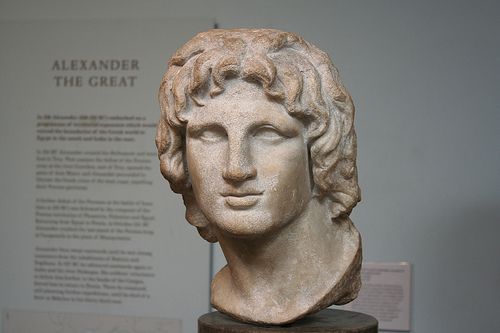
What a great nose, would be a shame to lose it…
It starts like any whimsical joke, so Octavian meets Alexander the Great. And, naturally, the end of it is marked with a well-placed punch. Not least of all, the humor in it accented by the fact that Alexander is, well, super dead.
To bring us back to this moment in time, Octavian who is soon to be remembered in history as Augustus Caesar, had just conquered Egypt. It was late summer of 30 BC, and with Mark Antony pooling in his deathbed from the fatal piercing of his own sword and Cleopatra having succumbed to an agonizing eternal slumber with the aid of poison (Whether it was administered by an asp remains a matter of debate [1]), there was no one left to stand in the way of Octavian and the spoils he was eager to enjoy of the once great Ptolemaic Kingdom that had ruled Egypt for the last 300 years. Perhaps the most cherished treasure of the city of Alexandria remained the tomb of its namesake and the most famous conqueror the world had ever witnessed, that of Alexander the Great. And, like his uncle before him who had strode in the presence of greatness at the behest of Cleopatra herself, Octavian too was avid to bear witness to the last man who, under the fierce gallop of his horse Bucephalus, had carved out and drastically changed the world. In hindsight, Octavian was perhaps also ignorant to the fact that he was about to be remembered for doing the same.
As the legend goes, after Alexander succumbed to illness (Because we have yet to find his body, all matter of possibilities have been suggested by scholars from poisoning, malaria, and even bowel perforation to being the cause of death) his body was encased in a golden sarcophagus filled with honey because why not also make him famously delicious and sent on its way to his homeland of Macedon despite his apparent wishes to be buried in the Egyptian oasis Siwah, thrown into a river as to attest to his godliness without evidence of a body, or be burned to ashes because then people couldn’t do exactly all of the things they eventually did to his corpse. [2] Unfortunately, one of Alexander’s generals and heirs, Ptolemy I, hijacked the procession and smuggled the body to Memphis in Egypt which he then began to rule after Alexander’s passing. From there, it remained in Ptolemaic possession, passing from Memphis to its famous resting place in Alexandria with a later Ptolemaic king swapping the golden sarcophagus with a glass one for a more economical viewing experience.
It was this resting place, now housed within the Soma Mausoleum, that Octavian wished to pay his respects.

Sebastien Bourdon, Augustus before the Tomb of Alexander
According to Suetonius, Octavian wished to gaze upon the body of Alexander the Great and show his respect by placing a golden crown upon his head. [3] Whether it was in placing the diadem or in the act of kissing the forehead of his idol, Octavian somehow managed to take off the nose of the greatest man to have walked the Earth, accidentally crushing it in the process of fealty. Whoops! [4]
“My wish was to see a king, not corpses.” – Octavian in response to being asked if he would like to see the tomb of the now vanquished Ptolemies in the most brutal clap-back ever recorded. Suetonius, The Life of Augustus para. 149
A part of me hopes that the irony of this event was not lost on Octavian. For the act of breaking the legacy of Alexander the Great lay with the destruction of Cleopatra’s kingdom and now, symbolically, with his nose. And it was from this moment on, really, that Octavian emerges as the next most famous conqueror in history, becoming the first and most powerful Roman Emperor to ever live.
As for what remained of Alexander, his body continued to fall victim to the whims and folly of other Roman Emperors. His tomb was looted by Caligula (You’d think he’d show some respect for a fellow equestrian, right?) and was tampered with by Caracalla (who delights in a good piss off, amirite?) after Septimius Severus tried sealing the tomb. [5] From there, no one really knows what became of Alexander the Great, whether his body was removed by a pesky Roman Emperor when stealing relics wasn’t enough or perhaps, engulfed into the sea with the rest of ancient Alexandria after a series of fatal earthquakes. Either way, amidst natural disasters and frequent sacking by other conquerors, the location of his tomb was eventually lost, waiting for the day when archaeologists and historians are hopefully able to recover it.
But one thing is for certain, the nose went first.
Fact Check it, yo!
[1] Cleopatra’s Death. (n.d.). Retrieved March 14, 2018, from http://penelope.uchicago.edu/~grout/encyclopaedia_romana/miscellanea/cleopatra/rixens.html
[2] Arrian. The Anabis of Alexander. Book VII Retrieved March 14, 2018, from https://archive.org/stream/cu31924026460752/cu31924026460752_djvu.txt
[3] Suetonius. The Life of Augustus. Retrieved March 14, 2018, from http://penelope.uchicago.edu/Thayer/E/Roman/Texts/Suetonius/12Caesars/Augustus*.html
[4] , Anthony Everitt. (2006) The Life of Rome’s First Emperor.
[5] Lindsay, I. (2014). The history of loot and stolen art: from antiquity until the present day. London: Unicorn Press Ltd.


